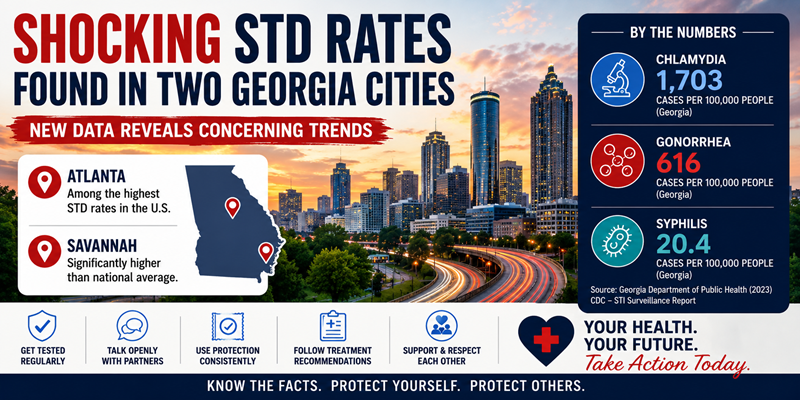
Recent public health data has placed two Georgia cities in the national spotlight after they reported some of the highest sexually transmitted disease (STD) rates in the United States. While the numbers are concerning, health experts emphasize that they should be viewed as a call to improve education, testing, and access to healthcare rather than a reason to stigmatize individuals or communities.
According to data from the Centers for Disease Control and Prevention (CDC) and the Georgia Department of Public Health (GDPH), infections such as chlamydia, gonorrhea, and syphilis continue to affect thousands o
Understanding why these cities report higher infection rates is essential for developing effective prevention strategies and helping residents make informed decisions about their sexual health.
Which Georgia Cities Report the Highest STD Rates?
Several national public health analyses have consistently ranked Atlanta among the U.S. cities with the highest reported STD rates. Other Georgia communities, including Savannah, have also experienced elevated infection rates compared with national averages.
Researchers caution that these rankings do not necessarily mean people living in these cities are engaging in riskier behavior than residents elsewhere. Larger populations, better disease surveillance, expanded screening programs, and easier access to testing can all contribute to higher reported case numbers.
Public health experts note that increased testing often identifies infections that might otherwise remain undiagnosed. In many cases, higher reported rates reflect stronger disease detection rather than a sudden increase in transmission.
Read more: Chemotherapy and Herpes
Two Cities at the Center: Columbus and Atlanta
Columbus, Georgia
Columbus has emerged as one of Georgia’s most concerning hotspots. Public health data shows the city reporting high rates of gonorrhea and syphilis compared to many other U.S. cities of similar size.
Health officials point to multiple contributing factors, including gaps in preventive education, limited routine screening, and socioeconomic barriers that can delay diagnosis and treatment. When infections go untreated, transmission chains can continue within communities, driving rates higher.
Local clinics in the area have reported increased testing demand, especially among younger residents. However, experts note that early detection and consistent treatment remain critical to reducing overall prevalence.
Atlanta, Georgia
Atlanta, the state’s largest metropolitan area, continues to report some of the highest STD and HIV rates in the country. Certain counties within the metro region consistently rank near the top statewide for new diagnoses of chlamydia, gonorrhea, syphilis, and HIV.
Urban density, mobility, and healthcare access disparities contribute to the city’s elevated case numbers. While Atlanta has numerous medical facilities and public health programs, barriers such as cost, stigma, and lack of awareness can still limit early testing and treatment.
Public health leaders emphasize that higher case counts in major metro areas often reflect both larger populations and more robust screening programs. Nonetheless, sustained high rates indicate the need for expanded prevention efforts.
Read more: The Silent Spread of Dormant STDs in the United Kingdom
Why Are STD Rates Increasing?
Experts believe several factors contribute to rising STD rates across Georgia and the United States.
Reduced routine screening during recent years delayed diagnosis for many individuals, allowing infections to spread unknowingly. At the same time, inconsistent condom use, limited sexual health education, and barriers to affordable healthcare continue to affect many communities.
Another challenge is that infections such as chlamydia and gonorrhea frequently cause few or no symptoms during the early stages. Without regular testing, many people remain unaware they are infected and may unintentionally transmit an STI to others.
Public health officials stress that routine screening remains one of the most effective tools for reducing transmission and protecting long-term reproductive and sexual health.
What the Numbers Indicate
The high STD rates in Columbus and Atlanta represent more than statistics—they highlight ongoing public health challenges:
1. Young Adults Disproportionately Affected
Individuals aged 15 to 24 account for a large percentage of reported STD cases. Chlamydia remains particularly common in this age group. Experts attribute this trend to biological vulnerability, inconsistent protection use, and limited routine testing.
2. Healthcare Access Gaps
Communities with reduced access to affordable healthcare often experience higher STD rates. Without regular screening, infections can remain undiagnosed and untreated, increasing the likelihood of transmission.
3. Social and Economic Factors
Socioeconomic disparities—including poverty, housing instability, and limited health education—can influence disease patterns. Areas with fewer resources may face greater challenges in implementing prevention initiatives.
Prevention and Response Efforts
Public health agencies across Georgia are implementing several strategies to address rising STD rates:
-
Expanded community testing programs
-
Mobile health clinics in high-incidence neighborhoods
-
Public awareness campaigns about safe sex practices
-
School-based sexual health education initiatives
-
Partner notification and treatment programs
Experts also stress the importance of reducing stigma around STD testing. When conversations about sexual health become normalized, individuals are more likely to get screened and treated promptly.
Frequently Asked Questions
Which Georgia cities have reported high STD rates?
Public health reports have consistently identified Atlanta among the U.S. cities with the highest reported STD rates. Other Georgia cities, including Savannah, have also reported elevated infection rates in recent years.
Why are STD rates increasing?
Health experts cite several contributing factors, including reduced routine screening in previous years, inconsistent condom use, limited access to healthcare in some communities, and the fact that many STIs cause few or no symptoms.
Can STDs be treated?
Many bacterial STIs, including chlamydia, gonorrhea, and syphilis, can be treated effectively when diagnosed early. Viral infections such as herpes and HIV can be successfully managed with appropriate medical care.
How often should I get tested?
Testing recommendations vary depending on age, sexual activity, and individual risk factors. Speak with a healthcare provider to determine the screening schedule that is right for you.
Medical Disclaimer
This article is intended for educational purposes only and should not replace professional medical advice, diagnosis, or treatment. If you have questions about sexually transmitted infections, testing, or treatment options, consult a qualified healthcare provider.
Looking Ahead
While recent data highlights serious concerns, public health officials emphasize that STDs are largely preventable and treatable. Routine screening, early diagnosis, and responsible sexual health practices remain the most effective tools for reducing infection rates.
As Georgia continues to monitor trends in Columbus, Atlanta, and other high-incidence areas, experts stress that sustained funding, education, and community engagement will be essential to reversing the upward trajectory.
The latest figures serve as a wake-up call—reminding communities that sexual health is a vital component of overall public health and requires ongoing attention and proactive action.
Reference: Many Georgia Cities Ranked In The Top 25 For The Highest STD Rates In The US
Sources
- Centers for Disease Control and Prevention (CDC) – Sexually Transmitted Infections Surveillance Reports.
- Georgia Department of Public Health (GDPH) – STD Surveillance and Prevention Data.
- National Institutes of Health (NIH) – Research on sexually transmitted infections and public health.
- American Sexual Health Association (ASHA) – Sexual health education and patient resources.
By combining accurate information with timely healthcare and community support, Georgia can continue making progress toward reducing STD rates while helping individuals protect their health without fear or stigma.