Last Updated August 2026
Dating with herpes can bring concerns about disclosure, rejection, intimacy, and trust. For Deaf and hard-of-hearing singles, dating may involve another important consideration: access to communication.
A person living with HSV may want a partner who understands herpes while also respecting Deaf culture, American Sign Language (ASL), captions, written communication, hearing technology, or another preferred communication method.
That combination can make finding a compatible partner feel challenging.
Understanding Genital Herpes
Genital herpes is a common sexually transmitted infection caused by herpes simplex virus type 1 (HSV-1) or herpes simplex virus type 2 (HSV-2). The CDC explains that many people have no symptoms or only mild symptoms that may be mistaken for other skin conditions.
Genital herpes is lifelong, but it can be managed. Antiviral medicines can shorten or prevent outbreaks, and daily suppressive therapy can reduce the likelihood of transmitting HSV to a sexual partner in appropriate situations.
These medical facts are important when dating because they allow both partners to make informed decisions.
Communication as a Strength in Deaf Dating
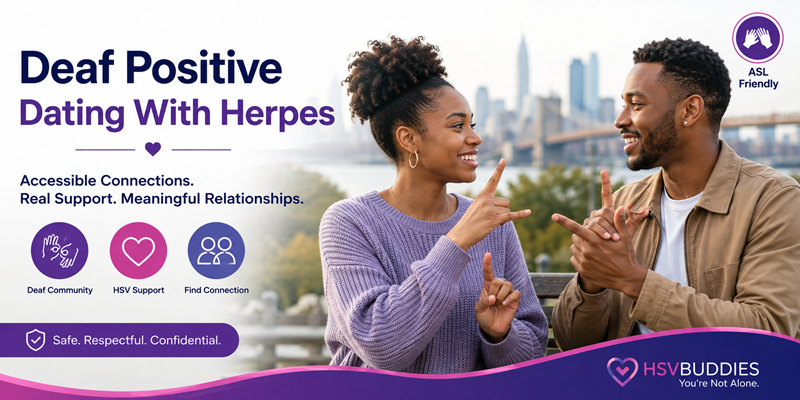
One of the most powerful aspects of deaf culture is its emphasis on communication. Many deaf individuals rely on visual communication methods such as sign language, facial expressions, and body language.
These communication styles can strengthen dating experiences by encouraging openness and attentiveness between partners.
Visual Communication Methods
Communication in deaf relationships may include:
-
Sign language conversations
-
Text messaging and written communication
-
Video calls with signing
-
Facial expressions and body language
Building Stronger Emotional Understanding
Because communication requires attentiveness, many deaf couples develop strong emotional awareness and deeper understanding in their relationships.
Why Deaf Positive Dating Can Have Additional Challenges
The emotional challenges associated with herpes can affect anyone. A person may worry about how a potential partner will react after disclosure or whether HSV will become the first thing another person notices about them.
For Deaf singles, communication can add another layer.
A new partner may not know ASL. They may not understand how captions, visual communication, speech reading, texting, or hearing technology fit into everyday conversations. A Deaf person may therefore have to explain communication preferences while also deciding when and how to disclose HSV.
This can make early dating feel more complicated.
The challenge is not that Deaf people cannot communicate effectively. The challenge is that communication access depends on whether both people understand and respect the communication method being used.
The U.S. Department of Justice explains that effective communication for Deaf and hard-of-hearing people can involve qualified sign-language interpreters, real-time captioning, written materials, or other auxiliary aids depending on the person’s communication method and the nature and complexity of the interaction.
Deaf People Are Not One Homogeneous Dating Group
The Deaf and hard-of-hearing community includes people with very different backgrounds, identities, communication preferences, and relationship goals.
Some Deaf people use ASL as their primary language. Others primarily use spoken English, hearing aids, cochlear implants, speech reading, captions, writing, or combinations of these approaches.
Some identify strongly with Deaf culture, while others may have become deaf or hard of hearing later in life and have different relationships with Deaf culture and language.
Dating preferences also vary.
- A Deaf woman in her 20s may have different priorities from a Deaf man over 50.
- A Deaf gay man may want a partner who understands both HSV and LGBTQ+ experiences.
- A Deaf bisexual person may have different concerns around identity and disclosure.
Someone who wants marriage may have very different expectations from someone interested in companionship or friendship.
The Importance of Accessible Sexual-Health Information
Accessible sexual-health information is especially important for people living with HSV.
A Journal of Health Communication study of 405 participants (166 Deaf ASL users) found that 48% of Deaf participants had inadequate health literacy and were 6.9 times more likely than hearing participants to experience it.
These results reflect communication and language barriers—not Deafness itself. People need accessible information to make informed health decisions.
A more recent study of 408 Deaf ASL users and 445 hearing participants found Deaf participants had 3.7 times higher odds of inadequate health literacy, with ASL proficiency and English reading ability strongly linked to outcomes.
For HSV education, this highlights the need for clear writing, captions, accessible web design, and ASL resources where available.
Expert Perspective: Dr. Poorna Kushalnagar
One of the leading researchers in Deaf health is Dr. Poorna Kushalnagar, Director of Gallaudet University’s Center for Deaf Health Excellence and an Associate Professor in Psychology.
The Center conducts patient-centred research with Deaf and hard-of-hearing ASL users and has collected accessibility and patient-reported outcome data from over 2,000 participants in the U.S.
In a 2026 Gallaudet report on healthcare access, Dr. Kushalnagar emphasized the difference between translation and true understanding of care. Interpreters can translate provider communication, but language-concordant support helps patients fully understand and act on health information.
FAQ: Deaf Positive Dating With Herpes
Can Deaf people date with herpes?
Yes. HSV does not prevent dating or relationships. Honest communication and mutual respect are key.
How should I disclose herpes?
Use your preferred method, such as ASL, texting, writing, or captions. Explain your status before sexual activity and allow time for questions.
Can herpes spread without symptoms?
Yes. HSV can sometimes be transmitted without visible sores.
Do condoms prevent herpes?
Condoms can reduce transmission risk but cannot provide complete protection.
Can Deaf patients request interpreters?
Yes. Depending on the healthcare setting, effective communication may include qualified interpreters or captioning.
Can Deaf LGBTQ+ singles date with HSV?
Absolutely. Deaf LGBTQ+ people with HSV can build meaningful relationships based on compatibility, communication, and trust.
Should everyone get tested for herpes?
No. The CDC generally does not recommend routine testing for people without symptoms. Discuss testing with a healthcare professional.
Can herpes end my dating life?
No. HSV is manageable, and many people continue to date, form relationships, and enjoy fulfilling lives.
Final Thoughts
Being deaf and living with herpes does not prevent someone from finding love, friendship, or meaningful companionship. Instead, these experiences highlight the importance of honesty, communication, and empathy in relationships.
By embracing openness and challenging stigma, deaf individuals living with herpes continue redefining what dating can look like.
Love and connection grow through understanding and respect. When partners communicate openly and support each other, relationships can thrive regardless of hearing ability or health status.
Every person deserves the opportunity to build genuine relationships based on trust, acceptance, and pride.