Last Updated August 2026
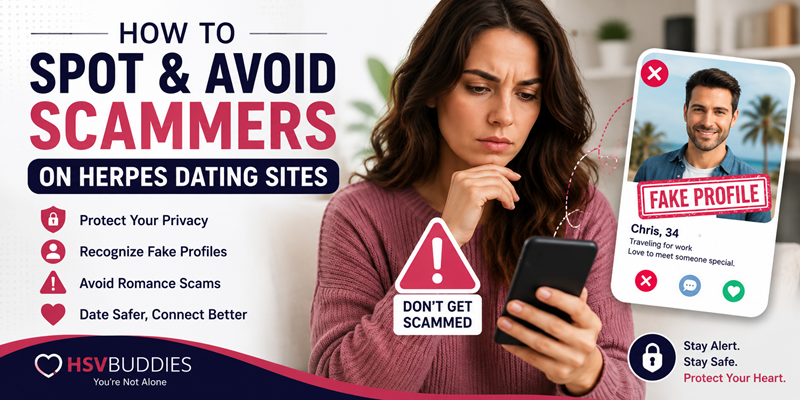
Dating online can make it easier for people living with herpes to connect with others who understand HSV and the challenges that can come with dating, disclosure, and relationships. Herpes dating communities can offer a more comfortable environment for meeting people, but they can also attract scammers who create fake profiles and manipulate users for money, personal information, or private content.
Knowing how romance scams work can help you protect yourself while remaining open to genuine connections. The goal is not to assume everyone is dishonest. Instead, it is to recognize warning signs, maintain healthy boundaries, and give trust enough time to develop.
This article combines online dating safety guidance from the Federal Trade Commission (FTC) with established health information from the World Health Organization (WHO). It is intended for educational purposes and does not replace advice from a qualified healthcare professional.
Why Scammers Target Online Dating
Romance scams often begin with conversation rather than a financial request. A scammer may create an attractive profile, communicate frequently, show strong interest, and make you feel emotionally connected before asking for anything.
The FTC reports that romance scammers commonly build relationships online and eventually ask for money or other financial assistance. Their stories can involve medical emergencies, travel problems, family difficulties, financial hardship, or investment opportunities.
Herpes dating sites can provide a particularly personal environment because members may discuss sensitive subjects such as sexual health, rejection, disclosure, intimacy, and past relationships. A dishonest person may try to use those conversations to create trust quickly.
Having herpes does not make someone more likely to be dishonest or more deserving of suspicion. Anyone can become the target of an online dating scam.
Understand the Difference Between HSV and Trust
Herpes simplex virus is a common infection. WHO reports that billions of people worldwide live with HSV-1 and hundreds of millions live with HSV-2. Many infections cause no symptoms or may go unrecognized.
HSV status tells you something about a person’s health history. It does not tell you whether that person is honest, respectful, financially responsible, or emotionally safe.
Someone claiming to have herpes is not automatically trustworthy. Likewise, someone who does not have herpes is not automatically unsuitable as a partner.
Evaluate people based on their behavior rather than assuming that a shared diagnosis guarantees trust.
Warning Signs of a Herpes Dating Scam
The Relationship Moves Too Fast
Be cautious when someone you have just met immediately describes you as their soulmate, talks about marriage, or makes major promises about your future together.
Strong feelings can develop online, but healthy relationships generally allow people time to learn about one another.
Scammers may deliberately create intense emotional connections because emotional attachment can make it harder to recognize suspicious behavior later.
If someone constantly tells you how special you are while simultaneously pressuring you to make financial or personal decisions, slow down.
Their Profile Information Is Inconsistent
Pay attention when details repeatedly change.
A person’s age, location, occupation, photographs, relationship status, or personal history should generally remain consistent. One small mistake does not prove that someone is a scammer, but multiple contradictions can be a warning sign.
The FTC recommends using a reverse image search if you suspect that a dating profile photograph may belong to someone else.
They Always Have a Reason They Cannot Meet
A person may have legitimate reasons for delaying an in-person meeting. However, repeated excuses deserve attention.
Someone might promise to visit and then suddenly experience a travel problem, medical emergency, work issue, or financial difficulty.
If the person also asks you to pay for their travel or emergency, the situation becomes significantly more concerning.
A genuine relationship should not require you to repeatedly solve financial problems for someone you have never met.
They Ask You for Money
This is one of the strongest romance scam warning signs.
Never send money to someone you have only met online simply because they claim to love you or need urgent help.
Scammers may describe emergencies involving medical treatment, rent, travel, family members, legal problems, or unexpected expenses.
The FTC advises consumers not to send money or gifts to an online romantic interest they have not met in person.
Your empathy is valuable, but it should not be used against you.
They Request Cryptocurrency or Gift Cards
Scammers may avoid asking for a traditional bank transfer. Instead, they might request cryptocurrency, gift cards, wire transfers, or another payment method.
These methods can make it difficult to recover funds after a scam.
If someone you met through a dating site tells you exactly how to send money and insists that the situation is urgent, stop before making any payment.
They Introduce an Investment Opportunity
Investment scams can become part of romance fraud.
A person may spend weeks building an emotional relationship before telling you about a supposedly profitable cryptocurrency, stock, trading, or investment opportunity.
They may show screenshots of profits or claim that they have special knowledge.
The FTC has identified investment opportunities among the stories romance scammers use to persuade victims to send money.
Never invest because an online romantic interest tells you that profits are guaranteed or that you must act immediately.
Protect Your Personal Information
Your money is not the only thing that needs protection.
Avoid sharing passwords, banking information, account recovery codes, government identification documents, your full home address, or other sensitive information with someone you have recently met online.
Think carefully before sharing private photographs as well.
Intimate images can potentially be misused for harassment, threats, or blackmail. You should never feel pressured to provide private content as proof that you care about someone.
Your HSV status is also personal information. You control when, how, and with whom you discuss it.
Take Your Time Before Moving Off the Dating Site
Some genuine relationships eventually move from a dating platform to phone calls, messaging, or other forms of communication. Moving conversations elsewhere is not automatically suspicious.
However, be cautious if someone immediately pressures you to leave the platform, refuses to communicate through normal channels, or becomes angry when you want to take things slowly.
Keeping early conversations on the dating platform can make it easier to maintain boundaries and report suspicious behavior.
What to Do If You Suspect a Scam
You do not have to continue communicating with someone just to prove that they are a scammer.
Stop sending money and avoid sharing additional personal information. Save relevant messages, profile details, photographs, and payment records if they may be needed for reporting.
Block the person when appropriate and report the profile to the dating platform.
If you have already sent money, contact your bank, card provider, payment service, or the company used to transfer the money as soon as possible. The FTC recommends explaining that the payment was made to a scammer and asking whether the transaction can be reversed.
Do not be embarrassed about reporting what happened. Scammers are deliberately skilled at creating emotional trust.
How to Date More Safely With Herpes
Safer herpes dating does not mean assuming everyone is suspicious.
Take time to learn about someone. Look for consistency between their words and actions. Ask questions. Protect sensitive information. Avoid financial involvement with people you have not met. Consider a video call before meeting in person, and choose a public location for a first meeting.
Tell a trusted person about your plans when meeting someone for the first time.
Most importantly, do not let fear of herpes stigma cause you to ignore behavior that would concern you in any other relationship.
You deserve both acceptance and respect.
Frequently Asked Questions
How can I tell if a herpes dating profile is fake?
Look for inconsistent information, reused photographs, unrealistic stories, rapid emotional attachment, repeated excuses for avoiding reasonable verification, and requests for money. No single sign proves a profile is fake, so consider the overall pattern.
Should I send money to someone I met online?
No. The FTC recommends not sending money or gifts to an online romantic interest you have not met in person.
Can someone use my HSV status against me?
Yes. Sensitive health information can potentially be used for manipulation or harassment. Protect private information and report threats or suspicious behavior.
Is someone a scammer if they refuse a video call?
Not necessarily. People have legitimate privacy and technical concerns. However, repeated refusal combined with inconsistent stories or financial requests should increase your caution.
Can I trust someone because they also have herpes?
No. A shared HSV diagnosis does not establish someone’s character. Trust should be based on consistent behavior, honesty, respect, and boundaries.
Final Thoughts
Dating with herpes can lead to meaningful relationships, but online connections should be approached with patience and awareness.
A trustworthy person will not need your money to prove your feelings. They will not pressure you for sensitive information, demand intimate photographs, or use your HSV status against you.
Take your time. Protect your privacy. Verify unusual claims. Pay attention to behaviour rather than promises.
Safe herpes dating is not about expecting the worst from everyone. It is about giving genuine connections enough time to prove themselves.