15 U.S. Cities With High Herpes Rates: What the Data Shows
Last Updated August 2026
Herpes is one of the most common viral infections in the United States, yet city-level herpes statistics can be difficult to interpret.
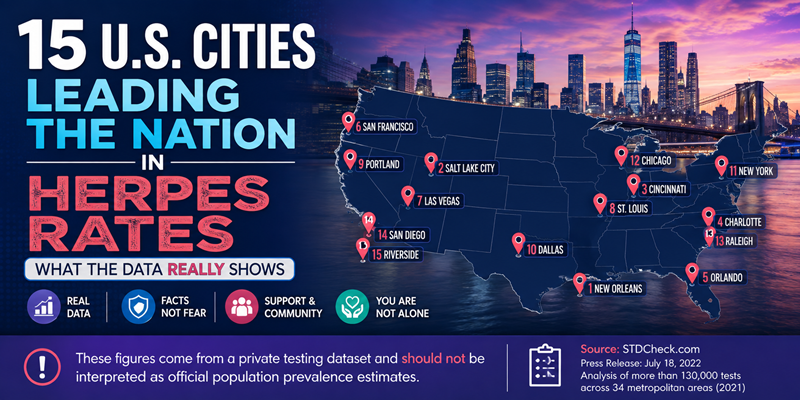
You may have seen lists claiming to identify the 15 U.S. cities with the highest herpes rates. These lists often include cities such as New Orleans, Salt Lake City, Cincinnati, Charlotte, Orlando, San Francisco, Las Vegas, and St. Louis.
But there is an important distinction between reported testing data and true population prevalence.
The CDC does not publish an official national ranking of cities by herpes prevalence because genital herpes is not a nationally notifiable condition. As a result, there is no comprehensive federal surveillance system that can accurately rank every U.S. city by the number of people living with HSV.
This article explains what available data can tell us, why some cities appear higher on herpes lists, and what the numbers mean for people living with HSV.
Is There an Official U.S. Herpes City Ranking?
No.
This is one of the most important facts to understand when reading online lists about herpes rates by city.
The CDC’s national STI surveillance system tracks nationally notifiable infections such as chlamydia, gonorrhoea, and syphilis. HSV is not included in that system because herpes is not nationally reportable.
That means there is no current CDC table that officially ranks:
- New Orleans
- Salt Lake City
- Cincinnati
- Charlotte
- Orlando
- San Francisco
- Las Vegas
- St. Louis
- Portland
- Dallas
- New York
- Chicago
- Raleigh
- San Diego
- Riverside
as America’s 15 highest-herpes cities.
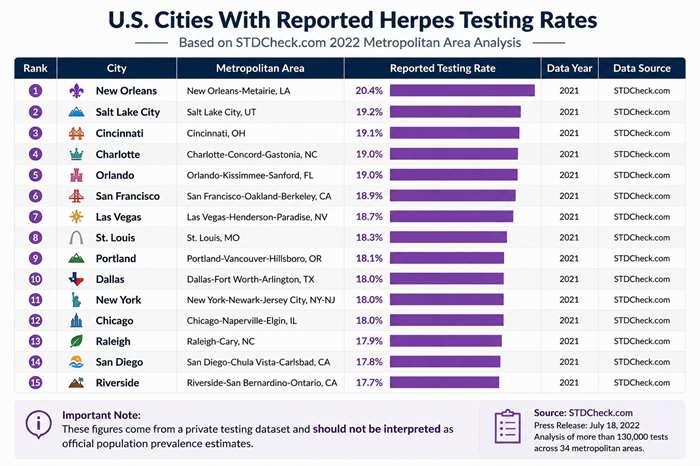
However, a widely cited 2022 analysis from STDCheck.com reported genital-herpes positivity among people tested through its service across 34 metropolitan areas. That analysis placed New Orleans-Metairie first at 20.4%, followed by Salt Lake City at 19.2% and Cincinnati at 19.1%.
The results are useful as a testing-based snapshot, but they should not be treated as a representative survey of every resident in those metropolitan areas.
15 U.S. Metropolitan Areas Reported in the STDCheck Analysis
The following list comes from the 2022 STDCheck analysis rather than CDC population surveillance:
STDCheck said its analysis was based on more than 130,000 tests conducted in 2021.
Important Data Limitation
These percentages represent the population included in that testing dataset.
They do not mean that exactly 20.4% of every person living in New Orleans had genital herpes.
People who take an STI test may differ from the general population in age, sexual behavior, healthcare access, symptoms, risk perception, and reasons for testing.
That is why these figures should be described as reported testing rates or positivity rates, rather than definitive city prevalence.
Why Is Herpes So Difficult to Measure?
Herpes presents a unique surveillance challenge.
Many people with HSV have no symptoms or have symptoms mild enough that they do not recognize them as herpes.
The CDC notes that most people with HSV-2 have not received a diagnosis.
Testing also has limitations.
The CDC recommends herpes testing for people with genital symptoms to help confirm a diagnosis. Routine blood testing for people without symptoms is generally not recommended in most situations because of limitations with available tests and the possibility of incorrect results.
Consequently, diagnosed cases represent only part of the total number of people living with HSV.
What Do We Know About Herpes in the U.S.?
Although city-level data are limited, national research provides a clearer picture.
CDC data from the 2015–2016 National Health and Nutrition Examination Survey estimated HSV-2 prevalence at 11.9% among people ages 14–49. Prevalence increased with age and was higher among females than males in that dataset.
A separate peer-reviewed analysis estimated that approximately 18.6 million people ages 18–49 had genital herpes in the United States in 2018, with an estimated 572,000 new infections that year.
These national estimates are different from city testing data and should not be directly compared as though they measure the same population.
New Orleans and Herpes Statistics
New Orleans frequently appears near the top of online herpes-rate lists.
The 2022 STDCheck analysis reported a 20.4% genital-herpes positivity rate for the New Orleans-Metairie metropolitan area, the highest among the 34 metropolitan areas included in that analysis.
That result has received considerable attention online.
However, it should not be interpreted as proof that New Orleans has the highest true herpes prevalence in America.
Differences in who gets tested, where testing occurs, and how data are collected can influence city-level results.
St. Louis and Herpes Rates
St. Louis is another metropolitan area frequently included in herpes statistics.
The same STDCheck analysis reported an 18.3% positivity rate for the St. Louis metropolitan area, placing it eighth among the 34 areas examined.
For Missouri residents, this figure can provide context when researching HSV in the region.
It should still be treated as testing data rather than a complete estimate of HSV prevalence among every St. Louis resident.
What About San Francisco, New York, and Chicago?
Large metropolitan areas can produce substantial testing datasets because they have large populations and extensive healthcare networks.
The STDCheck analysis reported rates of:
- 18.9% for San Francisco-Oakland-Berkeley
- 18.0% for New York-Newark-Jersey City
- 18.0% for Chicago-Naperville-Elgin
Again, these are results from the specific testing population used in the analysis.
Interestingly, an earlier population-based survey in New York City found an HSV-2 prevalence of 27.9% among adults in the NYC-HANES study. That research illustrates why results can differ considerably depending on study design, population, age range, and testing methodology.
Why Some Cities May Show Higher Rates
Several factors can influence observed herpes statistics.
Population Size and Density
Large metropolitan areas bring together millions of people with diverse social networks.
Population density can influence patterns of sexual contact, healthcare access, and testing.
Healthcare Access
Testing availability varies between communities.
Areas with more accessible sexual-health services may identify more infections than areas where testing is less accessible.
Testing Behavior
People who believe they may have been exposed to an STI may be more likely to test.
This can create a testing population with a different infection profile from the general population.
Awareness and Public Health Programs
Cities with strong sexual-health education and accessible testing may diagnose more infections.
A higher number of diagnosed infections does not necessarily mean transmission is occurring at a higher rate.
HSV-1 Is Also Important
Discussions about herpes rates often focus almost entirely on HSV-2.
That can create an incomplete picture.
HSV-1 is extremely common and can cause genital herpes as well as oral herpes.
A 2024 systematic review and meta-analysis examined 159 publications on HSV-1 in the United States. The researchers estimated pooled HSV-1 seroprevalence at 63.5% among general-population adults and found evidence that genital HSV-1 is becoming a more important part of genital-herpes epidemiology.
This is another reason why simple city rankings cannot tell the entire story.
Dating and Community Support
For people living with HSV, statistics can sometimes provide reassurance.
Knowing that herpes affects millions of people can make an individual diagnosis feel less isolating.
A dedicated herpes community can also provide opportunities to communicate with people who already understand HSV and the questions that can come with disclosure and dating.
PositiveSingles is one example of a dating and support community focused on people living with herpes and other STIs.
For people who prefer an environment where HSV is already part of the conversation, a dedicated community can make meeting others feel more comfortable.
Frequently Asked Questions
Which U.S. city has the highest herpes rate?
A 2022 STDCheck analysis reported New Orleans-Metairie as having the highest genital-herpes testing positivity rate among the 34 metropolitan areas included, at 20.4%.
This is not an official CDC population-prevalence ranking.
Does the CDC publish herpes rates by city?
No. Genital herpes is not a nationally notifiable condition, so CDC national STI surveillance does not provide a comprehensive city-by-city herpes ranking.
Is herpes common in the United States?
Yes. HSV is common in the U.S., and many infections are undiagnosed because symptoms may be absent or mild.
Are city herpes statistics completely accurate?
City-level figures depend on the source and methodology.
Testing-based studies can provide useful information but may not represent every resident of a metropolitan area.
Does a high herpes rate mean people in that city have more risky sex?
Not necessarily.
Testing rates, healthcare access, population characteristics, awareness, and study methodology can all influence observed results.
Final Takeaway
The idea of the “15 U.S. cities with the highest herpes rates” is more complicated than a simple ranking.
Available testing data have identified metropolitan areas such as New Orleans, Salt Lake City, Cincinnati, Charlotte, Orlando, San Francisco, Las Vegas, and St. Louis with relatively high reported positivity in specific datasets.
But the CDC has no authoritative national ranking of cities by herpes prevalence.
The bigger picture is clear: HSV is widespread, many infections remain undiagnosed, and herpes affects people across every region of the country.
Rather than focusing only on which city has the highest number, it is more useful to focus on accurate information, responsible testing, prevention, treatment, and reducing the stigma surrounding HSV.
For people living with herpes, support and connection can be just as important as statistics.
Sources
- Centers for Disease Control and Prevention — Genital Herpes and STI Treatment Guidelines.
- U.S. Department of Health and Human Services — HSV National Strategic Plan Addendum.
- CDC National Center for Health Statistics — HSV-1 and HSV-2 prevalence data.
- Peer-reviewed U.S. genital-herpes prevalence research.
- STDCheck — 2022 metropolitan-area testing analysis.
- Peer-reviewed systematic review of HSV-1 epidemiology in the United States.