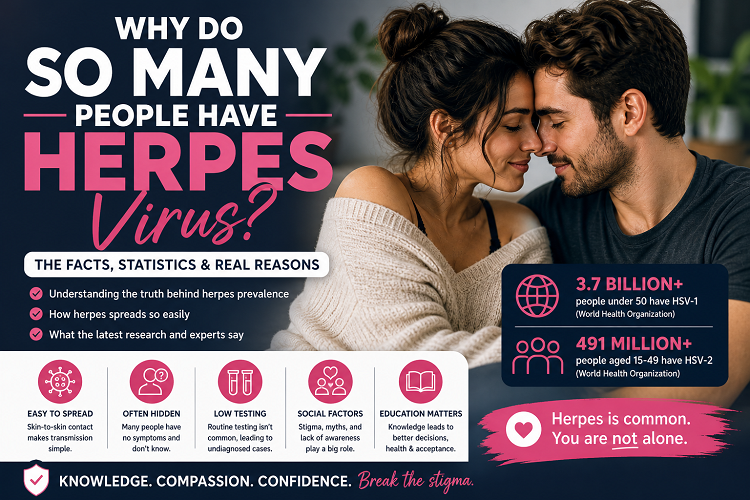
Why Do So Many People Have Herpes Virus? Facts, Data, and Real Understanding
Herpes is one of the most widespread viral conditions in the world, yet it remains one of the most misunderstood. Many people are surprised to learn just how common it is, often because public conversation around herpes is limited or shaped by outdated stigma.
This guide provides a deep, research-backed explanation of why so many people have the herpes virus, combining medical science, global statistics, expert insights, and real-world behavioral factors. The goal is to replace confusion with clarity and stigma with understanding.
How Common Is Herpes? A Global Perspective
Herpes is not rare. In fact, it is one of the most prevalent infections worldwide.
According to the World Health Organization:
- Approximately 3.7 billion people under age 50 have HSV-1
- Around 491 million people aged 15–49 have HSV-2
In the United States, the Centers for Disease Control and Prevention estimates:
- About 1 in 6 people aged 14–49 have genital herpes (HSV-2)
- A large percentage of adults carry HSV-1, often acquired in childhood
Data visualization insight
If this data were presented in a global chart:
- HSV-1 would cover a majority of the population
- HSV-2 would represent a significant but smaller segment
- A large portion of infected individuals would appear in a category labeled “undiagnosed or asymptomatic”
This visual gap explains why herpes feels uncommon, even though it is extremely widespread.
What Is the Herpes Virus?
Herpes simplex virus (HSV) exists in two main types:
- HSV-1: Commonly associated with oral herpes (cold sores), but can also cause genital infections
- HSV-2: Primarily associated with genital herpes
Both types are:
- Lifelong infections
- Manageable with treatment
- Often mild or asymptomatic
Understanding this helps reduce unnecessary fear and highlights why transmission is so common.
Why Does Herpes Spread So Easily?
1. Transmission Through Skin-to-Skin Contact
Unlike many infections, herpes does not require bodily fluids for transmission. It spreads through direct skin-to-skin contact, which makes it easier to pass between individuals during everyday interactions.
2. Asymptomatic Shedding
One of the most important reasons herpes is so widespread is asymptomatic transmission.
The Centers for Disease Control and Prevention explains that people can spread herpes even when they have no visible symptoms.
This means:
- Many people transmit HSV without knowing it
- Testing and diagnosis rates are lower than actual prevalence
3. Early Exposure in Life
HSV-1 is often acquired during childhood through non-sexual contact, such as:
- Kissing family members
- Sharing utensils or drinks
This contributes to the high global prevalence.
4. Lack of Routine Testing
Herpes testing is not always included in standard STI screenings unless symptoms are present.
The American Sexual Health Association notes that many people:
- Do not realize they have HSV
- Are never tested due to lack of symptoms
This leads to a large population of undiagnosed individuals.
5. Social Stigma and Communication Barriers
Stigma plays a major role in the spread of herpes.
Because of social discomfort:
- People avoid discussing their status
- Disclosure conversations are delayed or avoided
- Misinformation continues to circulate
Dr. Justin Lehmiller explains that stigma is largely driven by lack of education rather than actual medical risk. When people understand herpes, their attitudes become significantly more accepting.
Behavioral and Cultural Factors
Modern dating dynamics
Casual dating, multiple partners, and app-based connections can increase exposure opportunities. However, the key factor is not behavior alone, but lack of awareness and communication.
Misconceptions about risk
Many people assume:
- Herpes is rare
- It only affects certain groups
- It is always visible
These misconceptions lead to lower precaution and delayed diagnosis.
Normalization without awareness
Because HSV is so common, it often spreads quietly within populations without being openly acknowledged.
Expert Perspectives on Herpes and Society
Dr. Emily Morse emphasizes that understanding sexual health conditions is essential for building healthy relationships. She highlights that education reduces fear and improves communication.
Research supported by the National Institutes of Health shows that individuals who are informed about STIs are more likely to:
- Communicate openly
- Take preventive measures
- Maintain healthier relationships
Why Herpes Feels More Rare Than It Is
There is a significant gap between reality and perception.
If shown in a comparison graph:
- The actual number of people with HSV would be very high
- The number of people openly discussing it would be much lower
This mismatch creates the illusion that herpes is uncommon.
Emotional and Psychological Impact
The stigma around herpes often has a stronger impact than the condition itself.
Common emotional responses include:
- Fear of rejection
- Anxiety about dating
- Feelings of isolation
However, these feelings are often based on misconceptions rather than reality.
Breaking the Stigma Through Awareness
Understanding the facts helps shift perspective:
- Herpes is common
- It is manageable
- It does not define a person’s value or relationships
By increasing awareness:
- Conversations become easier
- Disclosure becomes less stressful
- Acceptance grows
What This Means for Relationships
People living with herpes can:
- Build meaningful relationships
- Maintain healthy intimacy
- Communicate openly and confidently
Education and honesty are the most important factors.
Frequently Asked Questions
Why is herpes so common worldwide?
Because it spreads easily through skin contact, is often asymptomatic, and many people are unaware they have it.
Can you have herpes without knowing?
Yes. Many people have no symptoms and are unaware of their status.
Is herpes dangerous?
In most cases, it is a manageable condition and does not affect overall health significantly.
Why isn’t herpes talked about more openly?
Stigma and misinformation discourage open discussion.
Final Thoughts
Herpes is common not because people are careless, but because:
- It spreads easily
- It often goes unnoticed
- It is surrounded by misunderstanding
When you look at the data, science, and expert insights together, a clear picture emerges:
Herpes is a normal part of human health, not an exception.
The more we replace stigma with knowledge, the easier it becomes to approach relationships, communication, and personal confidence with clarity and understanding.
Read more: How Herpes Singles Can Enjoy Love This Holiday Season